
AgTech Innovations
Innovations in Sustainable Agriculture and Food Systems
Explore AgTech Innovations
Agricultural technology, or AgTech, refers to the use of innovation, engineering, and digital tools to improve how food is grown, harvested, and distributed.
As climate change, population growth, and resource constraints challenge traditional farming systems, AgTech solutions are helping farmers produce more food while using fewer resources such as water, land, and energy.
These innovations are transforming agriculture through automation, data-driven decision making, and sustainable production methods.
Below are several emerging AgTech technologies shaping the future of food systems.
Jump to a topic:

Agrivoltaics
Latest Trends & Innovations
Recent innovations in agrivoltaics focus on improving system performance, efficiency, and scalability. One major trend is the optimization of system design. Researchers and companies are developing bifacial solar panels that capture sunlight from both sides, as well as new coatings that enhance light transmission and durability.
Another trend is the growth of dual-use business models. Farmers and energy developers are testing leasing and revenue-sharing agreements that allow both parties to benefit financially. Ecological designs are also gaining attention, including pollinator-friendly arrays and grazing-compatible systems where sheep or bees coexist with solar infrastructure. These projects promote biodiversity and improve ecosystem health while maintaining productivity.
California institutions such as UC Davis and UC Berkeley are some of the leaders in this research. Pilot programs across the state are testing different panel configurations, crop combinations, and materials to determine best practices for large-scale deployment.
Private companies are also expanding the technology’s reach. Sun’Agri, Insolight, and BayWa r.e. are among the leaders in developing adjustable, data-driven systems that optimize both crop yield and solar generation. Locally, the proposed Coyote Creek Agrivoltaic Ranch in Sacramento County demonstrates how agrivoltaics can be adapted to California’s agricultural conditions. The project aims to produce research data on energy generation, crop performance, and economic viability while advancing regional climate goals. With its combination of abundant sunlight, agricultural expertise, and strong renewable energy policies, California is well-positioned to lead the nation in agrivoltaic adoption.
What is it?
Agrivoltaics, also known as agrisolar or co-located solar, is an emerging clean technology that combines agriculture and solar power generation on the same land. The goal is to make farmland more efficient by producing both food and renewable energy in one location. Instead of separating farmland and solar farms, agrivoltaic systems integrate photovoltaic (PV) panels directly into agricultural settings.
These systems take different forms depending on local needs. Some use raised solar panels positioned above crop rows, while others employ light-filtering arrays designed for grazing animals or pollinator habitats. Engineers can adjust height, spacing, and tilt angles to balance sunlight for crops while maximizing energy production. This dual-use model represents a major step forward for agricultural technology (AgTech) by merging renewable energy generation with crop science and sustainable land management.
Agrivoltaics allows one piece of land to serve two purposes at once: farming and electricity generation. It reduces land-use competition between agriculture and energy infrastructure and increases productivity without expanding the footprint of development.
Why does it matter?
Agrivoltaics addresses several global challenges simultaneously. It helps meet rising energy demand, strengthens food security, and contributes to climate change mitigation. As farmland faces growing pressure from population growth and environmental stress, making land use more productive and resilient has become critical.
Agrivoltaic systems help conserve resources. The partial shade created by solar panels reduces soil temperature, lowers evaporation, and conserves water, which is particularly valuable in drought-prone regions such as California. Crops grown beneath the panels are shielded from extreme heat, frost, and heavy rainfall, leading to more stable yields as weather patterns shift.
Economically, agrivoltaics provides farmers with an additional income stream and generates and sells electricity to the grid. This diversification strengthens financial stability for farmers and contributes to renewable energy goals without taking fertile land out of production.
In California, agrivoltaic projects directly support state sustainability targets. They reduce carbon emissions, increase rural employment, and help the agricultural sector adapt to a changing climate.
Highlighted Green Careers
Agrivoltaics opens pathways across agriculture, engineering, and environmental science. Agrivoltaic Technicians install and maintain solar systems customized for farm operations. They ensure electrical and mechanical systems operate safely and efficiently. Agronomists and Crop Specialists analyze plant growth under varying light conditions, improving crop performance in shaded microclimates. Project Managers and Policy Coordinators oversee large-scale installations, handle permitting and compliance, and align projects with local and state renewable energy targets.
Additional opportunities exist in renewable energy design, environmental consulting, data analytics, and research. Because agrivoltaics connects multiple disciplines, it offers diverse career pathways for professionals interested in sustainability, technology, and the future of farming.
Farm-to-Consumer Traceability via Blockchain
Latest Trends & Innovations
Blockchain systems are evolving through integration with artificial intelligence, satellite monitoring, and Internet of Things (IoT) sensors. Sensors installed in shipping containers track temperature and humidity to prevent food spoilage. Satellites monitor land use to confirm responsible farming practices and discourage illegal deforestation. Artificial intelligence analyzes supply chain data to detect irregularities before they become large-scale problems.
These developments transform blockchain from a record-keeping tool into an active management system that predicts and prevents inefficiencies. The combination of digital traceability and environmental monitoring builds a smarter, more resilient food system.
California is already testing these systems. UC Davis and other regional research institutions are studying blockchain applications in agriculture to improve data integration and policy design. For a state that produces over one-third of the nation’s vegetables and two-thirds of its fruits and nuts, the implications are significant. Enhanced traceability could reduce waste, strengthen consumer confidence, and improve crisis response in one of the world’s largest agricultural economies.
What is it?
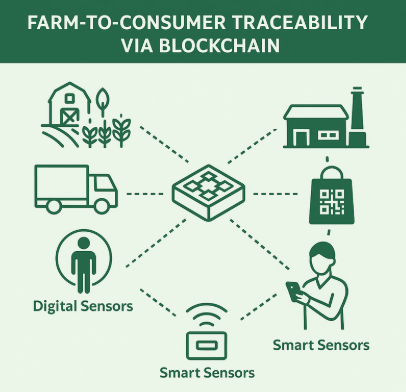
Farm-to-consumer traceability using blockchain technology provides a transparent way to track food products from the farm where they are grown to the person who purchases them. In a global food system that is large and complex, blockchain introduces accountability and trust by documenting each step in a product’s life cycle.
Blockchain is a digital ledger that stores information in blocks that cannot be altered once recorded. In agriculture, this means every event—from harvesting to shipping to retail sale—can be securely logged. Farmers record when crops are harvested, transporters document handling conditions, processors enter batch information, and retailers add shelf data. Many systems also use QR codes or smart sensors that collect real-time data. A consumer can scan a code on a package to see where a product was grown, who transported it, and how long it was stored.
This technology replaces a system that often operates behind the scenes with one that is open, verifiable, and data-driven. It builds confidence for consumers and fair recognition for producers, connecting both ends of the supply chain through transparency.
Why does it matter?
Blockchain traceability directly addresses environmental, economic, and public health challenges within the agricultural industry. One of the most critical issues is food safety. When outbreaks of E. coli or salmonella occur, it can take weeks to identify the source. Entire product lines are destroyed, and farmers lose revenue. With blockchain, investigators can trace contamination back to the source within seconds. This targeted approach reduces waste and prevents unnecessary recalls.
Traceability also strengthens consumer trust. Food fraud, such as false labeling of “organic” or “local” products, undermines sustainability efforts and disadvantages honest farmers. With blockchain, labeling claims are verifiable. Consumers gain control over what they buy, and authentic producers receive fair recognition.
Environmental responsibility is another benefit. By providing data on transportation, storage, and sourcing, blockchain can help reduce waste and encourage more sustainable practices across the supply chain. It supports a circular, data-driven approach to agriculture that rewards transparency and accountability.
Highlighted Green Careers
The expansion of blockchain in agriculture is creating new professional roles across technology, data management, and farming operations. Blockchain Developers design and maintain secure digital platforms for agricultural traceability. They ensure that data is encrypted, transparent, and interoperable across multiple stakeholders. Data Scientists analyze large datasets from sensors and transactions to identify patterns, optimize supply chains, and recommend sustainability improvements.
Agricultural Technologists work directly with farmers to integrate blockchain and IoT systems into production and logistics processes. Compliance Analysts and Auditors verify that recorded data meets food safety and sustainability standards, ensuring accuracy and regulatory alignment.
The Sacramento region’s identity as the Farm-to-Fork Capital makes it a natural hub for agricultural technology innovation. Blockchain supports the region’s commitment to local sourcing and traceable food production while aligning with state goals for climate-smart agriculture and waste reduction.
Water-from-Air Irrigation Systems
Latest Trends & Innovations
The next generation of atmospheric water generation focuses on efficiency and reduced energy demand. A recent breakthrough involves hydrogels, advanced materials that capture water vapor passively without the need for continuous power. These gels absorb moisture from the air at night and release it during the day through sunlight-driven heating. However, hydrogels currently face cost and lifespan limitations, requiring frequent replacement.
Startups such as AirJoule are exploring alternatives using metal-organic frameworks (MOFs) that achieve similar results with lower energy consumption. These materials act like sponges that selectively trap and release water molecules. The goal is to create devices that can operate efficiently even in arid climates where conventional AWGs struggle.
Companies such as Watergen lead the global commercialization of AWG systems. Their models are used in disaster relief, rural communities, and military operations to provide off-grid water generation. Researchers continue to improve performance through better heat exchangers, solar integration, and hybrid systems that combine moisture capture with renewable energy storage.
What is it?
Water-from-Air Irrigation Systems, also known as Atmospheric Water Generators (AWGs), are sustainable technologies that produce clean water directly from humidity in the air. These systems draw in air, filter it, and cool it until water vapor condenses into liquid. The collected water then passes through a series of filter and mineralization stages before it is ready for use.
The concept of extracting water from air is not new, but modern AWGs have evolved rapidly since 2015, when inventor Moses West popularized large-scale atmospheric water production. Depending on size and design, commercial AWGs can generate between 1 and 10,000 liters of water per day, while smaller household units typically produce 1 to 20 liters daily. Production rates vary depending on humidity and temperature, with the most efficient performance in areas above 65°F and with humidity above 30 percent.
By capturing water from the atmosphere instead of depleting groundwater, AWGs provide an innovative alternative for communities facing drought or limited water access. They can also operate with renewable power sources, creating a closed-loop system that supports climate resilience and resource efficiency.
Why does it matter?
Access to freshwater is one of the most urgent environmental challenges worldwide, and California is no exception. Extended droughts and declining snowpack threaten agricultural productivity and urban water supply. Water-from-air systems offer a promising solution by generating water locally without tapping existing reservoirs or groundwater tables.
Unlike desalination, which requires significant infrastructure and energy to treat seawater, AWGs can be deployed rapidly and operated on solar or wind power. Although initial installation and maintenance costs are high, they provide a scalable and flexible option for water-stressed communities.
For California farmers, AWGs could provide critical backup supply during dry seasons. The technology could reduce dependence on imported water, stabilize irrigation capacity, and protect crops when traditional sources are restricted. In residential or emergency settings, compact units could ensure access to drinking water during disasters or infrastructure failures.
Highlighted Green Careers
The growth of atmospheric water technologies is generating new career opportunities across engineering, materials science, and renewable energy. Mechanical and Electrical Engineers design and optimize AWG systems for higher efficiency, improved airflow, and renewable power integration. Materials Scientists develop advanced sorbents, hydrogels, and MOFs that reduce energy consumption and enhance water yield. Environmental Engineers assess system impacts, ensure water quality, and adapt designs for different climates and communities. Project Managers and Policy Analysts coordinate pilot deployments, navigate permitting, and align water-from-air initiatives with regional drought-resilience strategies.
Hydroponics - Solution for Urban Food Deserts
Latest Trends & Innovations
Recent innovations in hydroponics for 2024–2025 focus on integrating artificial intelligence, data analytics, and automation to improve performance and reduce resource use. AI Management Systems now analyze sensor data in real time to monitor plant health, nutrient balance, and growth patterns. They can detect early signs of pests or disease and automatically adjust nutrient levels, lighting, or temperature for optimal conditions. IoT Control Networks enable farmers to manage entire farms remotely through mobile devices. Smart sensors provide continuous data on environmental factors such as humidity, pH, and water temperature, ensuring consistent yields with minimal labor.
Several agricultural technology companies are leading these innovations. AeroFarms, a pioneer in aeroponics (a variation of hydroponics that uses nutrient mist), combines engineering, genetics, and data science to achieve efficient, high-quality harvests. Plenty applies robotics and artificial intelligence to vertical farming to reduce costs and energy use while increasing production. Bower Farming uses sensors, automation, and renewable energy integration to grow crops year-round while reducing water consumption by more than 90 percent compared to traditional agriculture.
Together, these advancements are making hydroponics more accessible, efficient, and sustainable, helping transform how cities grow and distribute food.
What is it?
Hydroponics is a method of growing plants without soil by using a nutrient-rich water solution that delivers essential minerals and oxygen directly to plant roots. This controlled system allows plants to grow faster and use fewer resources than traditional agriculture. In most hydroponic systems, a nutrient solution circulates from a reservoir to the plant roots and back again, conserving both water and fertilizer through continuous reuse.
Plants are typically supported by inert growing mediums such as rockwool, clay pebbles, or coco coir, which anchor the roots and provide structure. Because nutrients and oxygen are supplied directly, plants do not need to expend energy searching for resources in the soil. This results in higher efficiency, faster growth, and reduced waste.
Hydroponic systems can be set up in greenhouses, warehouses, or vertical farms, making them ideal for urban areas where space and soil quality are limited. They are a cornerstone of controlled environment agriculture and play a growing role in improving food access in cities.
Why does it matter?
Hydroponics addresses critical challenges in modern agriculture, such as water scarcity, limited arable land, and environmental pollution from pesticides and fertilizers. It also offers a reliable solution to food insecurity in urban “food deserts,” areas where access to fresh and affordable produce is limited.
Water conservation is one of hydroponics’ greatest strengths. The systems use up to 95 percent less water than traditional farming methods because water is captured and recirculated rather than lost to runoff or evaporation. Land conservation is another advantage. Since hydroponic farms do not require soil, they can be established in compact spaces, vacant lots, or even rooftops. This allows food production in cities while using up to 20 times less land than conventional agriculture. Reduced pollution results from eliminating soil degradation and minimizing the need for chemical pesticides and herbicides. Higher yields and faster growth are achieved by optimizing nutrient delivery, lighting, and environmental conditions.
California’s arid climate and recurring droughts make water efficiency a top agricultural priority. Hydroponics provides a pathway to conserve resources while maintaining productivity. For farmers and growers in the Sacramento region, hydroponic systems offer climate resilience by allowing crops to thrive indoors, protected from drought, pests, and temperature extremes. This adaptability supports regional food security and advances California’s clean economy goals.
Highlighted Green Careers
Hydroponics creates diverse career opportunities in agriculture, engineering, and sustainability. Hydroponic Growers or Technicians manage day-to-day operations in controlled environments. They monitor plant health, adjust nutrient levels, and oversee system maintenance. This role combines knowledge of plant biology with technical skills in irrigation and climate control. Controlled Environment Agriculture Specialists focus on the design and optimization of hydroponic systems. They use environmental monitoring software to maintain ideal growing conditions and implement efficiency improvements. Sustainability Consultants advise agricultural operations on sustainable practices, energy efficiency, and waste reduction. They evaluate system performance, develop recycling strategies, and help organizations align with environmental standards.
In California, these careers are expanding as cities invest in sustainable food systems. Hydroponics supports Sacramento’s “Farm-to-Fork” identity by enabling year-round, local food production within urban environments.
Why AgTech Matters
Agriculture sits at the intersection of food security, climate change, and resource management. As technology advances, AgTech innovations will play a critical role in building more resilient and sustainable food systems.
By exploring these technologies, students, educators, and ecosystem partners can better understand the opportunities emerging within the growing green economy.
Careers Connected to AgTech
Emerging agricultural technologies are creating new career opportunities across engineering, environmental science, food systems, and data analytics.
Examples include:
• Agricultural Systems Engineer
• Environmental Scientist
• Renewable Energy Engineer
• Agricultural Data Analyst
• Sustainability Consultant
Developed Through Green Careers Launchpad
This resource was developed by HUMANBULB interns as part of the Green Careers Launchpad internship program, where participants research emerging industries, develop educational resources, and explore real-world clean technology innovations.